
“There is a hidden agenda in the fragility of romance”.
– Alexander McQueen
Agenda setting
I
talked about the spiral of silence theory in the previous entry and stated that
media played an important role in it. But how do media influence public opinion
exactly? This question is answered thanks to the agenda setting theory,
developed by Max McCombs and Donald Shaw. Having taken a few courses related to
journalism, I was familiar with the concepts of agenda settings and gatekeepers,
but until I took this class I hadn’t really thought of them as part of a
theory. For me, gatekeepers and agendas were elements that just exist in media
because every medium –and every person– has different interests, opinions and approaches. I had all the pieces of the puzzle but never
stopped to put them all together.
The two main assumptions of McCombs’ and Shaw’s
agenda setting theory were: on the one hand, media don’t reflect reality, they
filter and shape it; and on the other hand, media concentration on certain
subjects leads the audience to regard them as more important. In short, and as
I said in my previous entry, media tells the public what to think about.
 |
| Agenda setting theory. Source: mctheory.wordpress.com |
During the
1968 presidential election, McCombs and Shaw conducted a study between 100
residents of Chapel Hill (North Carolina) to demonstrate their theory. They
compared the public's perceptions of which was the most important election
issue with the issues featured in local and national media, and proved a strong
correlation between both. Linking this with the spiral of silence theory again,
we can see how the events and opinions that appear in media are seen as most
important or “the majority”, and everything else –“the minority”– is shadowed
and eventually will lose more support.
In class, we saw and discussed a recent example of agenda settings: the Ebola birus. News about Ebola virus started appearing significantly in western media during summer in 2014. People in Guinea, Liberia or Sierra Leone keep getting infected by the virus and dying, but they no longer appear in media because the outbreak in western/northern countries has been eradicated. It's not a threat for us anymore, so it's regarded as something not important.
Gatekeepers
So how exactly are these agendas set up? First,
there are “compelling news events”: stories or issues that are generally viewed
as public interest. There’s no hidden agenda behind showcasing those news, although
the agenda might affect the approach given. And second, agendas are set through
gatekeepers, agents who decide if a message will be distributed by a medium or
not.
Picture the iconic scene of Gandalf standing in
Durin's Bridge fighting the Baldrog.
That bridge was described as so narrow that it had to be crossed in single
file line, allowing the dwarven defenders to quickly undermine the enemy
forces. Now let’s put both scenarios together, with Gandalf and the dwarves at
the same time: they’ll be the gatekeepers. Every single story must cross the
bridge to appear in the medium, but it won’t be a walk in the park. There will
be dozens of dwarves, each with different opinions and interests, examining the
story and shooting arrows at it if they don’t think it should be featured in
the medium. And at the end of the bridge, Gandalf will have the final decision
on whether the story shall or shall not pass.
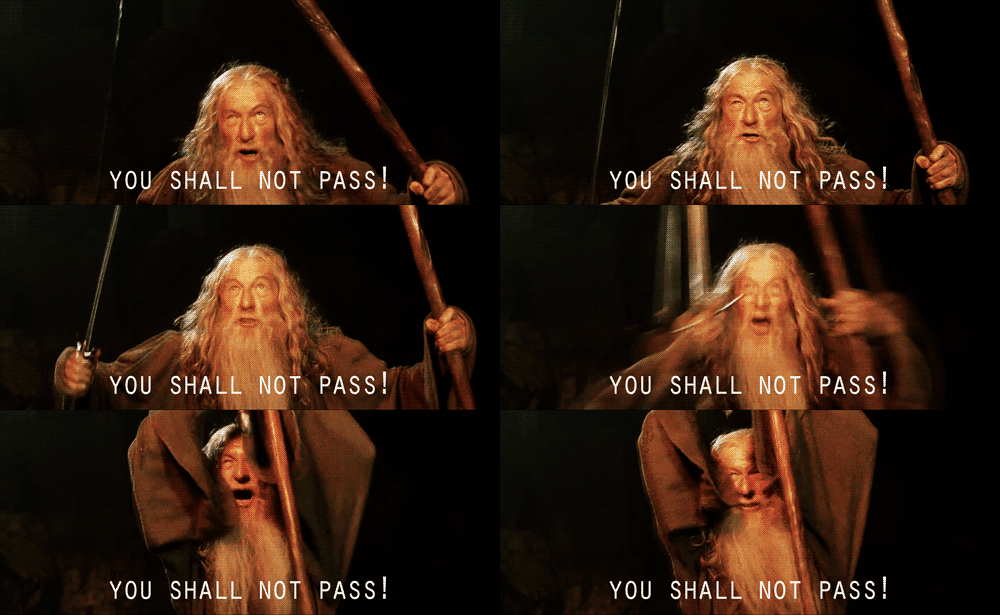 |
| Scene from LOTR: The Fellowship of the Ring. Source: tumblr.com |
In this particular scenario, the role of
Gandalf will be played by media owners and editors, and among the dwarves there
will be a variety of groups: journalists, Government, advertisers, lobbies, and
even things as basic as media formats and working routines.
Framing news
As
I anticipated, there is another way of enforcing agendas: choosing the approach
or, more specifically, framing the news. I found an example of this phenomenon
in October 2013 for another class project, and it illustrates perfectly how
news can be framed.
The 5th of October of 2013, there was a protest
in Bilbao in favour of Herrira, an organisation that supported the rights of
Basque prisoners. While Gara, a diary
that is known for sympathising with Basque independence, focused on the goals
of the protest and support that it obtained, La Razón, a diary known for having a strong right-wing ideology,
focused on political parties and figures who attended the protest and made
allusions to the terrorist group ETA.
 |
| Left: Gara, 6th October 2013. Right: La Razóm, 6th October 2013. |
The headlines read: “65,000 protesters take the
baton of Herrira in Bilbao” – Gara;
and “Bildu defies Justice after the police hit on Herrira” – La Razón.
Audience and algorithms
There’s
also a very important gatekeeper that I haven’t mentioned yet: the audience. If
a certain content works well, has a good audience, there will be more; if the
audience doesn’t respond very well, though, it will be discontinued. In
addition, with the new technologies and social networks, the public has the
chance to take more control. The Internet has two characteristics that
encourage users to talk about more topics, even less popular ones. On the one
hand, anonymity usually counteracts the fear of isolation mentioned in the
theory of the spiral of silence. Being anonymous can translate into feeling
more freedom to express unpopular opinions. On the other hand, now not only
journalists get articles and opinions published; anybody can start a blog or
simply speak in social networks about topics that don’t get coverage in other
media.
And
speaking of new technologies, search engines have gained importance as a source
of information. These engines, such as Google, use their own algorithms to
filter information and decide what’s more relevant; they have their own
gatekeepers too. As an activity, in class we run various searchs in Google and
compared the results we found in the first page. We googled several politicians
and other celebrities and in all cases the first results were their official
site, their Twitter accounts, Wikipedia articles, recent news in important diaries
and IMDb articles (in the case of actors and actresses). These are the sites
where users usually go for information about famous people, so perhaps the
public has a certain influence or weigh in these algorithms as well.


